

Figuring out how to keep a shrimp tank warm in winter for neocaridina comes down to picking the right size heater and a control style you will actually check. You are balancing four things: your Neocaridina strain and hardiness, your tank size, your current room and water parameters, and your budget. Small tanks lose heat fast overnight, so stability matters more than hitting a perfect number.
As of November 2026, I tell beginners to start with room swings, not just tank readings. If your room cools several degrees at night, even hardy cherry shrimp will slow down, eat less, and breed less. Browse our heater selection guides to compare form factors, then match wattage and placement to your exact setup.
What Actually Matters
Size Your Wattage to Tank Volume and Room Drop
Start with tank volume because every heater here lists a clear range. You will see coverage like 5 to 15 gallons for compact 50W models, up to 5, 10, 16, or 26 gallons as you step from 10W to 100W, and 10 to 30 gallons for a 100W class tube. Choose the right wattage according to the size chart, not by guessing. An undersized heater in a drafty room will run constantly and still swing.
For Neocaridina, keepers commonly report best breeding activity with stable temperatures in the mid 60s to low 70s Fahrenheit and very small day to night swings. That means you want a heater that cycles on and off gently, not one that blasts then shuts off. If your room regularly drops more than a few degrees, size toward the higher end of the rated range for your gallons and add a lid to hold heat.
Control Style and How You Read Temperature
Control style decides how easy winter care feels. Some models adjust across 64 to 90 degrees Fahrenheit, others offer 59 to 93 degrees, and knob style models cover 65 to 89 degrees. An external controller with LED digital display lets you set temperature without putting your hands in cold water, while a top knob plus separate digital thermometer gives you a second check. Free thermometer stickers are handy for a quick glance but read them as a backup.
Whatever you pick, verify with a second reading before you trust the dial. I recommend you test your GH and KH before winter and log temperature morning and night for three days. Heat changes how shrimp molt and how minerals behave, so stable parameters matter as much as the set point. If the display and the separate thermometer disagree, go with the thermometer and adjust slowly.
Physical Size, Cord Length, and Placement
In a shrimp tank, every inch counts. Compact tubes in this group measure about 7.7 inches long, thumb size options run only 4.1 inches or 10.5 cm, and standard 100W tubes run about 8 inches. That difference decides whether you can hide the heater behind plants or a sponge filter in a small cube. Check cord length too, with examples like 4.92 ft and 47.24 inchs in this set, so you can reach your outlet without tension.
Place the heater where flow passes over it, usually near filter output and fully submerged, and keep it 100 percent underwater during use. Horizontal low placement often spreads heat more evenly in shallow shrimp tanks than vertical corner placement. Leave space from substrate and leaves so detritus does not bake on the glass, and use suction cups to keep it from shifting.
Safety Features and Build Quality
Look for quartz glass construction, with some tubes using 2mm thickened quartz for explosion resistance and corrosion resistance. Rubber sealing layers help prevent leaks compared with basic plastic seals, and nickel chromium heating wire is noted for rapid, even heating. These details matter in winter when a heater cycles more often.
Protection circuits are just as important. Good models stop heating when water exceeds 95 degrees Fahrenheit or when water level drops below the minimum, showing codes like HH for high temp and E1 for out of water. Indicator lights help, with red for heating and green for holding temperature on some models. Always unplug before water changes and let the tube cool, with one maker advising a 15 minute cool down before handling.
To see how these tradeoffs look in real gear, here are a few options that show the range. They cover tiny nano tanks up to mid size colonies, plus different ways to set and monitor temperature.
This article contains affiliate links. If you buy through one of our links, Shrimpyo may earn a commission at no extra cost to you. Commissions never influence which products we recommend or how we rank them. Read our Affiliate Disclosure for details.
Quick Picks at a Glance

Prime DaToo 50W Mini Aquarium Heater for 5-15 Gallon
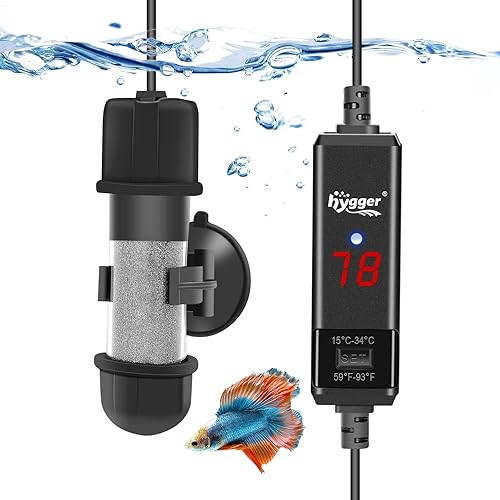
Prime hygger Small Aquarium Betta Heater with LED

Prime HiTauing 100W Aquarium Heater for 10-30 Gallon
As an Amazon Associate we earn from qualifying purchases. Product prices and availability are accurate as of the date/time indicated.
Pros
- Ultra compact size ideal for small desktop and nano tanks
- Precise adjustable range suits bettas and most tropical fish
- Durable quartz glass with rubber seal for added safety
- Simple red and green light system shows heating status clearly
Cons
- Must be fully submerged at all times, which limits placement flexibility
- Only suitable for 5 to 15 gallons, not for larger aquariums
- 110V to 120V power only, so not compatible with 220V outlets abroad
The DaToo DTMAH-3 is a 50 watt mini heater built specifically for small 5 to 15 gallon aquariums. It is aimed at betta owners and beginners with desktop glass or acrylic tanks who need simple, space saving heating.
It offers an adjustable 64 to 90F range that automatically holds your set temperature. The red light shows active heating while green signals the target temp is reached, so daily care stays hands off and predictable.
At just 7.7 inches long with a 4.92 ft cord, it tucks easily into corners vertically or horizontally. The quartz glass tube plus rubber sealing layer feels tougher than basic plastic seal models and is made for full submersion.
The full submersion requirement means you must plan placement carefully and never run it exposed. It is also strictly a small tank solution, so larger setups will need a higher wattage model.
Overall, this is a practical, beginner friendly heater for nano and small tropical tanks. If you want compact size, stable control, and added safety touches, the DaToo Mini 50W is easy to recommend.
Power: 50W, Voltage: 110V to 120V, 50 to 60Hz for indoor use.
Size: 7.7 x 0.9 x 0.9 inches with 4.92 ft power cord, weight 6.7 ounces.
Range: Adjustable 64 to 90F, 18 to 32C, for 5 to 15 gallon glass or acrylic tanks.
Model: DaToo DTMAH-3 in Black, includes heater and thermometer sticker, must be fully submerged.
Pros
- Ultra compact size ideal for small 1 to 5 gallon betta tanks where standard heaters will not fit
- Hands-free external control with clear LED readout for easy, accurate adjustments
- Strong safety coverage with automatic shutoff for overheat, low water and target temp
- Compatible with both freshwater and saltwater in glass or acrylic aquariums
Cons
- Must select correct wattage from size chart, undersized or oversized choice reduces efficiency
- Max setting of 93F may not suit species that need higher tropical temperatures
- Requires unplugging for tank cleaning and water changes, which adds a manual step
The hygger HG-031 is a mini submersible heater designed for small aquariums from 1 to 26 gallons. It is built for betta keepers, nano tank hobbyists and turtle owners who need reliable heating without bulky equipment taking over the tank.
The standout is the external LED controller that lets you check and set temperature from 59 to 93F without reaching into water. Once set, it holds temp steadily and shuts off automatically, with F and C display options for easy reading.
At only 4.1 inches long, the 2mm thickened quartz tube hides easily behind decor and resists corrosion in fresh and saltwater. The compact black housing feels solid and helps prevent direct contact burns for curious fish and invertebrates.
It is not a set and forget unit for large tanks, so matching wattage to tank size is critical. You also need to unplug it during cleaning or water changes, and the 93F upper limit will not cover every high heat species.
For nano and betta setups, this hygger heater delivers an excellent mix of size, safety and control. With overheat and dry run protection plus memory backup, it is a dependable, space saving choice for small freshwater and marine tanks.
Brand: hygger, Model: HG-031, Material: 2mm Quartz Glass, Color: Black
Wattage Options: 10W for up to 5 gal, 25W for up to 10 gal, 50W for up to 16 gal, 100W for up to 26 gal
Temp Range: 59 to 93F adjustable, Safety Cutoff at 95F with HH alert, Dry Run E1 alert
Use: Submersible for freshwater and saltwater glass or acrylic tanks, Size: 1.2 x 1.2 x 4.14 inches
Pros
- Available in 25W to 300W options to fit nano tanks up to large aquariums
- Easy manual knob adjustment with wide 65-89F range
- Comes with digital thermometer included in the box
- Safe for freshwater, saltwater, betta and turtle tanks
- Compact submersible design with suction cup for secure mounting
Cons
- Glass tube runs hot and needs 15 minutes cool down before handling during water changes
- No built-in digital display on heater, relies on separate thermometer for readings
- Analog knob control is less precise than full digital controller heaters
The HiTauing AP05 100W is a submersible aquarium heater designed for 10 to 30 gallon freshwater and saltwater tanks, including betta and turtle setups. It is best suited for beginners and budget conscious hobbyists who want simple manual temperature control with an included thermometer.
Performance centers on straightforward knob adjustment from 65 to 89 degrees Fahrenheit with set and forget operation. Once you set the desired temperature and submerge the unit, the red indicator light shows active heating and turns off when the target is reached, while the separate digital thermometer allows real time checks.
Build quality features a nickel chromium heating element for fast warm up inside a thickened glass tube for added durability. At 8 inches long with a long power cord and suction cup mount, it installs vertically and stays discreetly hidden behind plants or decor.
There are some tradeoffs to consider, as the glass housing gets hot and must cool for 15 minutes before handling during water changes. The analog knob also lacks the fine precision of a digital controller, so you will want to verify readings with the included thermometer.
Overall, this is a practical and versatile heater for small to medium community tanks where simplicity and value matter. If you need reliable basic heating for bettas, turtles or tropical fish without complex features, it is an easy recommendation.
Model: AP05-100W, 100W power rated for 10-30 gallon tanks.
Temperature Range: 65-89F adjustable via top control knob.
Dimensions: 8 inch heater body with 47.24 inch power cord.
Construction: Nickel-chromium element with thickened glass tube, fully submersible.
In the Box: 100W heater body, suction cup mount, separate digital thermometer.
Matching Gear to Your Tank
If you run a 1 to 5 gallon desktop tank, focus on the smallest footprint and precise low end control. The hygger Small Aquarium Betta Heater fits this niche because its 10W version is rated up to 5 gallons, its 4.1 inch body hides easily, and its external controller with LED display lets you tweak without chilling your hands. Pair it with a lid and a sponge filter for gentle flow, and use that 59 to 93 degree range to hold steady without overshooting.
If you run a 5 to 15 gallon Neocaridina colony in a room that cools overnight, pick a compact 50W that can hold the middle without crowding shrimp. The DaToo Mini Aquarium Heater 50W Small Fish Tank is built for that window, with a 7.7 inch body, 64 to 90 degree adjustment, and simple red for heating and green for holding lights. Mount it low near flow, keep it fully submerged, and use the included thermometer sticker plus your own thermometer for the first week. See our breeding tank setup ideas to pair stable heat with grazing surface.
If you run a 10 to 30 gallon tank or a rack that gets cold, consider a larger adjustable tube with a separate readout. The HiTauing Aquarium Heater 25W/50W/100W/200W/300W line includes a 100W option rated for 10 to 30 gallons, measuring 8 inches with a 65 to 89 degree knob and a separate digital thermometer for real time checks. That combo helps when you want set it and forget it operation but still want to spot drift early. Remember to adjust the knob before plugging in, then watch the red light cycle as it locks in.
Common Mistakes
Mistake 1: sizing by tank alone and ignoring the room. A 50W tube rated 5 to 15 gallons can be perfect in a heated apartment but struggle in an uninsulated space that drops fast. Track night room lows for a few days, then choose toward the top of the rated gallons if you see big swings.
Mistake 2: trusting the dial and skipping a second thermometer. Knobs and displays can read a little high or low, and a small drift matters for molting. Keep a separate digital thermometer or sticker on the opposite side of the tank and log readings before you adjust.
Mistake 3: exposing the heater during water changes. Draining below the minimum line, touching hot glass, or plugging back in too soon can crack tubes or trigger overheating protection. Unplug first, do your change, refill to full submersion, wait for temperatures to equalize, then plug back in and confirm the light cycle.
My Experience
I keep a 10 gallon cherry colony in a room that cools off a lot in November, so I chose a compact 50W rated for 5 to 15 gallons and set it inside the 64 to 90 degree window to hold steady. I mounted it low and horizontal behind the sponge filter, kept it fully submerged, and double checked with a separate thermometer plus a sticker for the first week. The red to green cycling evened out within two days, berried females stayed active, and I learned to pair heat with leaf litter for grazing, as I noted in our botanicals for stable water guide.
Who Should Wait or Buy Differently
If your room holds steady through cold months and your Neocaridina already breed, a heater is not ideal for you right now and you may do better with a lid and monitoring first. This type of compact heater is also not a good fit for tiny jars under a gallon, for outdoor tubs that can freeze, or if you need cooling in summer rather than heating in winter. Wait, track temperatures for a week, and buy differently if you see overheating instead of chilling.
Frequently Asked Questions
What winter temperature should I target for Neocaridina?
Keepers commonly report steady activity in the mid 60s to low 70s Fahrenheit with minimal day to night change. Avoid chasing a single perfect number and focus on holding a very narrow window. If shrimp cluster, stop grazing, or females drop eggs, check for swings before raising the set point.
Can I leave the heater plugged in all winter?
Yes, if it is fully submerged, correctly sized for your gallons, and showing normal on and off cycles. Use the LED display or separate thermometer to confirm daily, especially after water changes. Unplug for maintenance and let the tube cool before handling.
Will a 50W heater cook my 5 gallon shrimp tank?
Not when it is rated for 5 to 15 gallons and you set it carefully inside its 64 to 90 degree range. Start low, verify with a second thermometer, and adjust in small steps over a day or two. If the room is already warm, monitor closely or choose a smaller wattage rated up to 5 gallons.

Write Your Review
No reviews yet. Be the first to share your experience!