
If you are learning how to set up a ro system for a shrimp tank for cherry shrimp, the real decision is not which box looks best. It is how you will turn variable tap water into the same clean, repeatable water every week. Cherry shrimp are hardy by shrimp standards, but they still stress, stop breeding, or fail molts when chlorine slips through, dissolved solids swing, or minerals crash between water changes. Before you shop, weigh your shrimp hardiness and colony goals, your tank size and weekly water change volume, your current tap parameters, and your budget for replacement cartridges and storage.
Always follow the manufacturer's dosing chart for your specific remineralizer, remineralize gradually rather than all at once, and test your water after dosing to confirm you are in a safe range before adding shrimp.
You do not need reef lab purity to keep cherries alive, you need consistency you can maintain. That means thinking about where the unit will live, how you will collect and remineralize the water, and how often you want to change filters. If you are new to pure water, browse the RO System + Remineralize guides first so the whole workflow makes sense. Updated for November 2026, this framework will help you pick a setup you will actually use.
What Actually Matters
Filtration Stages and Why DI Still Helps Hardy Shrimp
Most shrimp focused units use four to six stages. The usual order is a sediment filter for sand and rust, a carbon block for chlorine and odors, a reverse osmosis membrane for the bulk of dissolved solids, and a deionization resin stage for final polish. That last DI stage is what brings output TDS close to zero and helps prevent algae fuel and metal traces from reaching a breeding tank.
For cherry shrimp you could technically run RO only, but keepers commonly report more stable results with RO plus DI because you start from a true blank slate and then remineralize. Look for color changing DI resin that shifts from blue or purple toward tan or brown, so you have a visual cue for replacement. If your city uses chloramines, check the manual carefully, because many compact aquarium units note they handle chlorine but not chloramines, and you may need extra pretreatment or a different carbon setup.
Output Rate, Pressure, and Real World Patience
Output is listed in GPD, or gallons per day, under ideal test pressure. In the data set here you will see compact options rated around 50 GPD, midsize options around 75 GPD and 100 GPD, and larger multi stage systems built around a high capacity 150 GPD membrane. Those numbers assume adequate cold water pressure, often above 45 psi with best results closer to 60 psi, and actual production drops with cold water, low pressure, or an aging membrane.
Think in terms of your weekly routine, not the headline number. A single small cherry tank with modest water changes can run fine on a slower unit if you make water overnight into a storage brute or jug. A rack or fish room with several tanks needs faster output or longer planning. If you want tighter control over swings, read about accurate TDS control and match your unit size to how much finished water you can store, not just how much the membrane can theoretically make.
Monitoring, Filter Changes, and Running Costs
An RO system is only as good as its maintenance. At minimum you want a way to know when to act. That can be a handheld TDS meter, an inline meter, a built in pressure gauge, or a clear DI housing where you can see resin color change. Pressure monitoring helps you spot a clogged sediment filter or low supply pressure early, which protects the more expensive RO membrane and keeps waste ratio in a sane range.
Compare cartridge style before you buy. Standard 10 inch housings are widely available and simple to source, while twist in quick change cartridges are faster with no tools but lock you into that brand line. Units with quick connect fittings, included tubing, wall clips, and clear English instructions save a lot of frustration. Budget for sediment, carbon, and DI resin on a regular cycle, with membranes lasting longer when prefilters are changed on time and the membrane is flushed as directed.
Installation Style and Storage Reality
Decide if the unit will be permanent or portable. Under sink installs with a supply adapter are tidy for daily use, while garden hose adapters, long supply tubing, and wall mount brackets work well in a fish room or garage. Compact portable designs suit apartments and rentals where you cannot drill, and you can hang the unit only during water making day and store it after.
Filtration precision down to 0.0001 micron sounds impressive, but it also means slow, steady drips, not faucet flow. Plan for a clean food grade container with a lid, an air stone or small pump for mixing minerals, and a heater if your room runs cold. Without storage, even a fast membrane feels slow, and with good storage, even a modest GPD unit feels effortless for cherries.
Below are a few options that show the range, from compact starter units to higher output multi stage systems, so you can see how stages, GPD, and features compare:
This article contains affiliate links. If you buy through one of our links, Shrimpyo may earn a commission at no extra cost to you. Commissions never influence which products we recommend or how we rank them. Read our Affiliate Disclosure for details.
Quick Picks at a Glance

Prime FilterFutureX 4-Stage RO+DI Aquarium Filter
Aquatic Life RO Buddie 4-Stage RO/DI Aquarium

Aquatic Life Twist-In 4-Stage RO/DI Aquarium

Prime Filterelated 4-Stage Aquarium RO DI System

Koolermax AR-122 6-Stage RO+DI Aquarium Reef

NU Aqua 4-Stage RODI Reverse Osmosis System 100
As an Amazon Associate we earn from qualifying purchases. Product prices and availability are accurate as of the date/time indicated.
Pros
- Produces ultra-pure near-zero TDS water that helps prevent algae growth and fish disease
- 100GPD output supports daily top-offs and water changes for marine and breeding setups
- Pressure gauge and visual DI resin simplify monitoring and maintenance timing
- Compact wall-mounted design with sturdy metal bracket saves valuable space
- Quick-change standard cartridges lower long term maintenance time and effort
Cons
- Requires wall mounting near a water source and drain plus adequate inlet pressure for best results
- DI resin and pre-filters are consumables that need regular replacement, especially with hard source water
- No storage tank included, so you need your own clean container to make and hold product water
The FilterFutureX 4-Stage RO+DI System is purpose built for aquariums that need truly pure water, not just filtered tap water. It is a smart pick for reef keepers, coral growers, crystal shrimp breeders and high end planted tank hobbyists.
Filtration combines PP cotton, activated carbon, a 0.0001 micron RO membrane and DI resin to target sediment, chlorine, organics, heavy metals and dissolved ions. In real world use, that means near zero TDS output that helps reduce algae growth and keeps sensitive livestock more stable.
Build quality centers on practical fish room use with a sturdy metal wall mount bracket and compact housings that free up counter space. The integrated pressure gauge plus transparent DI housing with color changing purple resin makes it easy to monitor performance and time cartridge swaps.
As with all RO plus DI units, you will need decent inlet pressure and a place to mount the system near a water source and drain. The DI resin and pre filters are consumables, so plan on routine replacement, especially if your source water is hard or you make large volumes.
Overall, this 100GPD system hits a strong balance of purification power, water saving efficiency and easy maintenance. For hobbyists upgrading from tap conditioners to true RO plus DI water, it delivers the purity and control that sensitive aquariums demand.
Brand: FilterFutureX, Model: 4-Stage Aquarium Reverse Osmosis System, Purification Method: Reverse Osmosis plus Deionization.
Capacity: 100 gallons per day, Filtration Precision: 0.0001 micron RO membrane, Media: PP cotton, activated carbon, RO membrane, DI resin.
Dimensions: 15.21L x 9.19W x 7.02H inches, Mounting: Wall Mount with metal bracket, Cartridges: Standard 10 inch quick change design.
Monitoring: Integrated pressure gauge and transparent DI housing for visual resin check, Special Feature: TDS reduction for aquarium health.
Use RO plus DI water for reef tanks, shrimp breeding and sensitive plants where tap minerals cause algae or molting issues. Always remineralize for freshwater species that need specific GH and KH levels.
Check inlet pressure with the built in gauge and flush the membrane on first use for best TDS rejection. Store product water in clean food grade containers with a lid and heater if needed.
Watch the purple DI resin for darkening and replace pre filters on schedule to protect the RO membrane. This keeps TDS near zero and extends system life.
Pros
- Produces true 0 TDS water ideal for reef tanks and soft water setups
- Easy to set up and portable enough to use at laundry sink or take to different faucets
- Compact wall mount design saves space and suits apartments and fish rooms
- Color changing DI resin makes maintenance timing clear and simple
Cons
- Does not remove chloramines, so some city water users need extra treatment
- 50 GPD output is slow for larger tanks and requires planning ahead
- DI cartridge plugs and supply hose fittings can be very tight on first setup
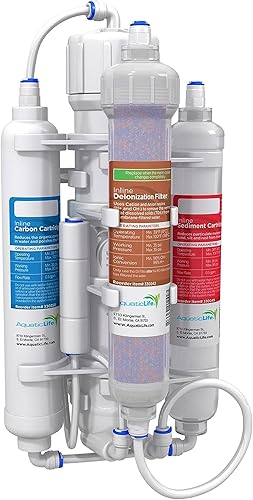
The Aquatic Life RO Buddie is a compact 4-stage reverse osmosis and deionization system built for aquarium hobbyists. It is designed for nano reef keepers, freshwater aquarists and plant growers who need pure, low TDS water from tap.
Water passes through sediment, carbon, RO membrane and color changing DI resin to deliver polished zero TDS output. In real world use, it handles moderately soft tap water well and creates gentle, stable water for sensitive corals, fish and carnivorous plants.
Weighing under four pounds and measuring just under 14 inches long, the unit is truly portable and wall mountable. Cartridges connect with simple push fittings, and the DI resin shifts from blue to tan so you know exactly when replacement is due.
It is not perfect for every home. It will not remove chloramines, flow is slow for larger volume tanks, and some users find the DI plugs and hose connections very tight on first setup.
Overall, the RO Buddie stands out as an affordable, reliable entry into RO/DI filtration. If you maintain a small to medium aquarium and want clean water without hauling jugs from the store, it is an excellent buy.
Filtration: 4-stage sediment, carbon block, RO membrane, DI resin. Purification method: Reverse osmosis and deionization for aquarium use.
Performance: 50 GPD output, supports up to 500 PPM inlet TDS. Max temperature rating 100F, compact non electric operation.
Design: Wall mount and portable, measures 13.75 x 7.5 x 6 inches and weighs 3.9 pounds. Includes RO Buddie cartridge system with 1-year limited warranty.
Pros
- Tool-free twist-in cartridges make filter changes quick and beginner friendly
- Produces very low TDS water, often 3 to 5 ppm in real world use, ideal for remineralizing
- Compact and leak-free build fits easily under sinks or in fish rooms
- Versatile for reef tanks, freshwater tanks, houseplants and drinking water
Cons
- Slow output flow means filling large tanks or 20 gallon containers takes several hours
- Does not remove chloramines, so it may not suit some city tap water without pretreatment
- Replacement cartridges and DI resin add ongoing cost
The Aquatic Life Twist-In 4-Stage RO/DI Filter is a compact 75 GPD system built for aquarium hobbyists who need pure starting water. It is ideal for reef, freshwater, planted tanks and even sensitive houseplants where tap water causes issues.
It uses sediment, carbon block, RO membrane and color-changing DI resin to cut chlorine, particulates and dissolved solids. Users report crystal clear water at 3 to 5 ppm, which is easy to remineralize for specific fish, corals and plants.
The twist-in cartridge design needs no tools and keeps maintenance clean and fast. The 4 x 13 x 12 inch unit weighs 7 pounds, mounts under a sink and includes a faucet adapter, membrane and wrench for setup.
Flow rate is slow at about 0.05 gpm, so filling large volumes requires planning and patience. It also does not treat chloramines and replacement filters can add up, so check your local water report first.
For hobbyists with chlorine, nitrate or high TDS tap water, this is a reliable and user friendly upgrade. If you want simple upkeep, compact size and consistently pure water for aquariums, it is a smart choice.
Filtration Stages: Sediment, carbon block, 75 GPD RO membrane, mixed-bed color-changing DI resin
Capacity: 75 gallons per day, max 0.05 gpm flow, supports up to 1000 PPM incoming TDS
Installation: Under sink with faucet adapter included, dimensions 4 x 13 x 12 inches, 7 pounds
In the Box: RO unit, cartridges, membrane, faucet adapter and membrane wrench
Pros
- Produces true 0 TDS water verified by users for saltwater and freshwater tanks
- Quick, tool-free setup with quick connect fittings and included accessories
- Compact and lightweight portable build ideal for apartments, RVs and rentals
- Flushing valve simplifies maintenance and helps extend RO membrane life
Cons
- Instructions and valve labeling can be confusing on first setup and may need checking
- Some units arrive with loose tubing that must be fully seated to prevent leaks
- Requires cold water feed and adequate 60 PSI pressure for rated 100 GPD output
The Filterelated DFET-ZRO-A100P is a 4-stage RO plus DI system built for aquarium hobbyists who need soft, near zero TDS water at home or on the go. It suits both freshwater and saltwater tanks up to 100 gallons, plus portable use in apartments, RVs and boats.
In real use, the PP cotton, carbon, 100 GPD NSF RO membrane and mixed bed DI resin deliver clean water down to 0.0001 micron. Users report consistent 0 TDS output for saltwater mixing and water changes, with noticeably healthier, more stable tank conditions.
The unit measures just 6 x 9 x 14 inches and weighs 4.7 pounds, so it fits under cabinets or mounts to a wall with included clips. Quick connect fittings, a 13 foot hose and cold water operation keep setup portable and renter friendly.
Setup is not perfect, as instructions and flushing valve labeling can be reversed or unclear and tubing may need reseating to avoid leaks. You will also need good water pressure near 60 PSI and cold water only to hit the rated output.
Overall, this is a practical, affordable choice for fish keepers who want simple maintenance and visual DI color change from blue to brown. If you want portable 0 TDS water without a permanent install, it is easy to recommend.
Model: Filterelated DFET-ZRO-A100P, 4-stage RO DI filtration for aquariums and residential use.
Filtration: PP cotton plus activated carbon plus 100 GPD NSF RO membrane plus color changing mixed bed DI resin, 0.0001 micron precision.
Performance: Up to 100 gallons per day at 60 PSI with flushing valve, final TDS near 0 ppm for fresh and saltwater use.
Design: 6 x 9 x 14 inches, 4.7 pounds, plastic housing, wall mount clips and 13 foot hose included for portable setup.
Pros
- Consistently reduces tap water to 0 TDS for sensitive reef tanks
- Fast output supports large aquariums and frequent water changes
- Complete installation kit with tubing, adapters and spare fittings
- Color changing DI resin and US based support simplify maintenance
Cons
- Requires 45 psi or higher inlet pressure for best flow and output
- Push to connect fittings need careful seating and tightening to stay leak free
- Included diagrams are basic and DI resin should be installed promptly to avoid premature discoloration
The Koolermax AR-122 is a complete 6-stage reverse osmosis plus deionization system built for reef aquariums, hydroponics, aeroponics and other ultrapure water needs. It connects under the sink or to a garden hose valve and is a smart fit for hobbyists doing regular water changes.
Its 150 GPD TFC membrane paired with sediment, dual carbon and dual color changing DI stages reduces typical 300 ppm tap water to near 0 TDS. In real use it delivers about 5 gallons per hour with sufficient pressure, giving reef keepers consistently pristine top off and mixing water.
The unit measures 16 x 5.5 x 16 inches and arrives complete with filters, tubing, drain saddle, inlet and outlet hoses and both under sink and hose adapters. Assembly in Santa Ana, CA plus included spare fittings and US based tech support add confidence for first time installers.
It needs at least 45 psi inlet pressure to hit rated output, so low pressure homes may need a booster pump. Some users report needing to carefully tighten push fittings to get a fully leak free setup, and the included diagrams are basic for beginners.
For aquarists tired of hauling store bought water, the AR-122 is a reliable, high output and economical path to true 0 TDS water. With proper pressure and careful setup, it delivers excellent purity and long term value for reef tanks.
Model: Koolermax AR-122, 6-stage RO plus DI with 150 GPD TFC membrane, rated for 120 gallons per day average output.
Filtration: Sediment filter, dual carbon filters, RO membrane, plus dual color changing DI resin that darkens when exhausted.
Requirements: 45 psi minimum inlet pressure, 100F max temperature, supports up to 300 ppm incoming TDS, under sink or garden hose installation.
Dimensions: 16L x 5.5W x 16H inches, 17 pounds, includes filter set, tubing, drain saddle, hoses, manual and adapters.
Pros
- True 4-stage process with sediment, carbon, RO membrane and DI resin for exceptional purity
- Designed specifically for aquariums with support for saltwater, freshwater and reef tanks
- User friendly quick connect design makes setup and filter replacement easy
- Includes faucet, tank and installation hardware so no extra parts to hunt down
- Strong ownership package with 120-day trial, 3 year warranty and lifetime support
Cons
- 100 GPD output is slow for large water changes and requires planning or storage
- Bulky 18 x 12 x 18 inch footprint needs dedicated under sink space
- Requires 45 to 100 psi water pressure and regular filter changes for best performance
The NU Aqua Reef Series is a 4-stage RODI deionization reverse osmosis system rated at 100 gallons per day. It is built for aquarium hobbyists with saltwater, freshwater and reef tanks who need consistently pure, low TDS water.
Its four stage process tackles sediment, chlorine and organics, then uses a high rejection RO membrane followed by a DI polishing filter. In real world use, this means cleaner top off and mixing water that helps reduce algae issues and supports coral and fish health.
Design is practical for home use with under sink installation, quick connect fittings and included faucet, tank and hardware. The plastic tube style housing feels sturdy for regular use while keeping filter swaps fast and downtime low.
Drawbacks are typical for this category. Flow is slow by nature, so large tanks will need storage planning, and you will need proper water pressure and space for the unit. Ongoing sediment, carbon and DI replacements are part of ownership.
Verdict: For dedicated aquarium keepers, this is a complete and convenient path to RODI water without piecing together parts. The trial period, warranty and lifetime support add real confidence for first time RODI buyers.
System Type: 4-stage RODI with sediment, carbon block, RO membrane and DI polish. Capacity rated at 100 gallons per day for aquarium use.
Installation and Size: Under sink setup measuring 18L x 12W x 18H inches and weighing 15 pounds. Includes system and filters, faucet, tank, manual and hardware.
Performance and Requirements: Targets up to 99.99 percent TDS reduction with chlorine reduction. Operates at 45 to 100 psi and 41 to 100 degrees F.
Matching Gear to Your Tank
For a single cherry tank in an apartment with chlorinated tap, simplicity wins. The Aquatic Life RO Buddie 4-Stage Aquarium Water is a classic example of this class, with sediment, carbon, RO membrane, and color changing DI in a small footprint. The 4-Stage Aquarium Reverse Osmosis System shows the same idea with a flushing valve and compact portable layout plus a long hose for temporary hookup. Look for easy filter access, clear resin color cues, and a setup you can connect, make a few gallons overnight, then put away.
If you run two or three tanks or do larger weekly changes, step up to faster and easier to service designs. The Aquatic Life Twist-in 4-Stage RO/DI Aquarium illustrates the twist in approach, where cartridges swap with no tools and output is rated around 75 GPD for quicker batches. The 4 Stage Reverse Osmosis Aquarium Water Filter represents the 100 GPD wall mount style with transparent housing and an integrated pressure gauge, which helps you learn how your home pressure affects production and when prefilters are loading up.
For a breeding rack, fish room, or very challenging tap water, consider higher capacity multi stage units. The AR-122 6-stage RO+DI Aquarium Reef Reverse Osmosis uses dual carbon stages plus dual DI stages around a high capacity membrane to extend polish and handle heavier loads. The NU Aqua 4-Stage RODI Deionization Reverse Osmosis shows the more premium choice in the 100 GPD class with quick connect fittings and a focus on build quality and support. Pair either type with serious storage for remineralized RO water so you are never forced to do a rushed water change with unfinished water.
Common Mistakes
Mistake 1: pouring near zero TDS water straight into a cherry tank. Pure RO plus DI water has almost no buffering or minerals, so shrimp can osmotic shock and molts can fail. Always remineralize in a separate container, mix thoroughly, test, and match temperature before it touches livestock.
Mistake 2: buying for headline GPD and ignoring pressure and flushing. Low supply pressure, cold feed water, and a membrane that was never flushed or has clogged prefilters will all cut output and raise waste. Check your feed pressure, flush a new membrane as directed with cold water only, and replace sediment and carbon on schedule to protect membrane life.
Mistake 3: skipping testing before and after. Test tap, test fresh RO, and test after remineralizing, and log it. Keepers who skip this often chase pH while the real issue is drifting minerals or exhausted DI resin. A basic routine with a TDS meter plus liquid kits for core parameters, linked to GH/KH mineral basics, prevents most cherry shrimp surprises.
My Experience
I keep a small cherry colony alongside a Caridina tank, and I chose a compact 4 stage RO plus DI unit with a wall bracket because I rent and need to set up only on water change day. I run it into a lidded container overnight, remineralize the next morning, aerate while I test, then do a slow change in the afternoon. Once I stopped rushing and started watching DI color and pressure behavior, my berried females held better and molts looked clean and complete.
Who Should Wait or Buy Differently
If your tap is already soft, stable, chlorine free after conditioning, and your cherries are breeding and molting well, an RO system is not ideal for you right now and adds work without benefit. It is also not a good fit if you have no place to store water, no way to remineralize and test, or you need instant faucet flow for large emergency changes. In those cases, focus on conditioning, substrate stability, and regular small changes first, then revisit RO when you want tighter control or plan to keep more sensitive shrimp.
Frequently Asked Questions
Do cherry shrimp really need RO water?
Not always. Many colonies thrive on conditioned tap if it is consistent and free of copper, ammonia spikes, and extreme hardness. RO helps when tap is unpredictable, too hard, contains chloramines your conditioner cannot handle well, or you want identical water for every change.
What GPD rating should I pick for one cherry tank?
Focus on storage more than speed. A lower GPD unit run overnight easily covers a small tank, while multiple tanks or frequent large changes favor 75 GPD, 100 GPD, or higher capacity membranes. Keepers commonly report that low home pressure cuts real output, so a pressure gauge and realistic planning matter more than the label.
Can I use RO water without remineralizing for cherries?
No, do not use near zero TDS water directly for livestock. Remineralize in a separate container following your mineral maker directions, mix well, and verify with a TDS meter and liquid tests before adding to the tank. Stable, matched water beats chasing a perfect number.

Write Your Review
No reviews yet. Be the first to share your experience!