

If you are trying to build a gh kh mineral dosing chart for shrimp tank for baby shrimp, you are really trying to answer one question: how do I turn empty RO water into stable, shrimplet friendly water every water change? The decision comes down to shrimp species and hardiness, tank setup in general terms, your current water parameters, and budget. Get those four right and babies molt cleanly instead of getting stuck.
In this 2026 guide, updated for November, I will walk you through how to choose between GH only and GH/KH blends, powder and liquid formats, and how to read any dosing chart without chasing numbers. If you want more background on the category, browse my GH/KH Mineral + RO Water guides before you mix your next bucket.
What Actually Matters
GH Only Versus GH Plus KH: Match It to Your Shrimp
The first choice is chemistry, not brand. GH only products raise general hardness without significantly influencing carbonate hardness, which suits bee, bumblebee and tiger shrimp kept in buffering soil that already pulls pH down. GH/KH blends raise both total hardness and carbonate hardness at a set ratio, which suits Neocaridina setups that run best in neutral water with some buffering.
To decide, test your tank and your source water first. If you use active soil and your KH already reads very low and stays there, you usually do not need added KH. If you keep shrimp from neutral habitats where keepers commonly report wanting a little KH for pH stability, a GH/KH blend makes more sense. Never mix a GH only powder and a GH/KH powder in the same bucket to invent your own ratio.
Powder Scoop Versus Liquid Pump: How You Like to Dose
Powder minerals are concentrated and you stir them into water outside the aquarium until dissolved. The label example from this category is 1 measuring spoon to 10 liters, and one 200g container is described as sufficient for up to 1,000 liters of aquarium water. That format rewards you if you mix buckets each week and want a long lasting supply.
Liquid minerals dose by milliliters and dissolve fast, which many beginners find less intimidating for tiny top offs. They are handy when you only need to nudge a bucket, but you will go through bottles faster on larger routines. For step by step mixing visuals, see this how to remineralize RODI water for shrimp and copy the stir, wait, then test rhythm.
How to Read Any Dosing Chart Without Overdosing
Every reliable chart works the same way. Start from pure RO, rainwater or fully desalinated water, add a measured amount, stir completely, then measure GH, KH and TDS before the water touches shrimp. One product here lists 1 level spoonful (approx. 2g) per 10 liters to reach 6dGH, while another lists a ratio of dGH/KH: 1.0/0.5. Always follow the manufacturer’s own dosing chart for your specific product, because ratios and spoon sizes are not interchangeable.
For babies, stability beats hitting a perfect number on day one. In a new tank, start with a smaller dose than the label suggests, then test the water after dosing and adjust slowly on the next bucket. Keepers commonly report mixing a full bucket the night before a water change, testing, then only using it if GH, KH and TDS look steady. That pause gives undissolved particles time to clear and prevents a sudden swing in the nursery tank.
Stability Factors That Matter More for Babies
Baby shrimp do not handle swings well. They need the same minerals adults need for molting and osmoregulation, including calcium, magnesium, potassium and sodium, but they need them delivered consistently. You should judge a mineral by how repeatable it is in your hands, not just by what is on the label. A simple scoop you can level the same way each time often beats a complicated system.
Also think about plants and filter bacteria. Several minerals in this group mention support for plant growth and microbial regeneration of filter substrates, which helps a breeding tank stay clean between changes. If you run a planted nursery, you want a formula that supports both shrimplets and plants without pushing KH up when you did not plan for it. Test before and after every batch until your routine feels boring and repeatable.
Below are a few options that show the range from GH only powders for soft water Caridina to GH/KH blends for neutral tanks and liquids for small adjustments. Use them to compare format and intended shrimp type while you build your own gh kh mineral dosing chart for shrimp tank for baby shrimp.
This article contains affiliate links. If you buy through one of our links, Shrimpyo may earn a commission at no extra cost to you. Commissions never influence which products we recommend or how we rank them. Read our Affiliate Disclosure for details.
Quick Picks at a Glance

Prime SaltyShrimp Bee Shrimp Mineral GH+ 110g
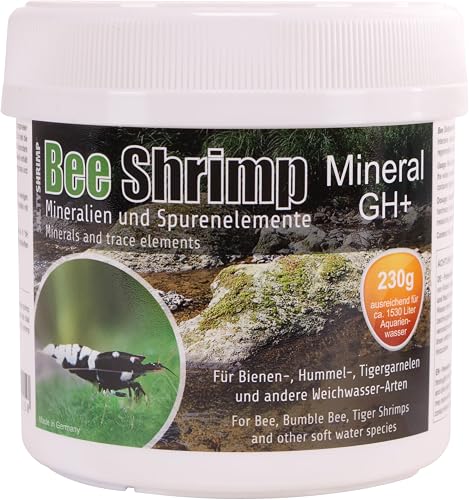
Prime SaltyShrimp Bee Shrimp Mineral GH+ 230g

Prime SaltyShrimp Shrimp Mineral GH/KH+ 200g

Prime SaltyShrimp Shrimp Mineral GH/KH+ 100g

Prime Brightwell Aquatics Caridina GH+ Shrimp Mineral

Prime Brightwell Aquatics NeoTiger KH GH+ Mineral
As an Amazon Associate we earn from qualifying purchases. Product prices and availability are accurate as of the date/time indicated.
Pros
- Creates ideal low KH to GH ratio for Caridina health and breeding
- Promotes successful molts, vibrant color and active breeding behavior
- Does not spike pH or KH, safe for buffered low pH setups
- Easy to dose soluble powder with consistent, reliable results
- Also benefits plants and bio filtration in shrimp tanks
Cons
- Requires RO, distilled or rainwater plus a GH and TDS test kit for best accuracy
- Not suitable for Neocaridina or hardwater species that need higher KH
- Powder must be fully pre dissolved to avoid temporary parameter swings
SaltyShrimp Bee Shrimp Mineral GH+ is a specialized remineralizer designed for Caridina keepers using RO, distilled, rainwater or fully desalinated water. It is built for Crystal Red and Black, Bee, Bumblebee and Tiger shrimp that thrive in soft, low KH water.
Its standout formula raises general hardness without significantly raising carbonate hardness, creating the ideal low KH to GH balance for molting and breeding. Keepers report more stable parameters, stronger coloration, active breeding and better shrimplet survival compared to tap water conditioners.
The fine powder dissolves cleanly and doses precisely for small to mid size aquariums, and the compact 110g jar stores easily and lasts a long time. It supplies essential minerals and trace elements that also benefit plant growth and help regenerate biological filter media.
It will not directly change pH, which is ideal for buffered aquasoil tanks but means you still need proper substrate and testing. Beginners will need a GH test kit and a TDS meter to dial in dosage, as overdosing can stress sensitive shrimp.
For anyone serious about keeping or breeding softwater Caridina shrimp, this is a proven, trusted staple. It delivers consistent water chemistry and healthier colonies, making it highly recommended for dedicated shrimp tanks.
Brand: SALTYSHRIMP, Model: SSM-NBSM-110, Form: Soluble mineral powder, Size: 110g jar for remineralizing RO water.
Target Species: Bee shrimp, Crystal Red and Black, Bumblebee, Tiger and other softwater Caridina shrimp. Function: Raises GH without significantly raising KH and does not directly affect pH.
Source Water: RO water, distilled water, rainwater or fully desalinated water. Best used with GH and TDS testing for precise control in planted and breeding tanks.
Start with clean RO or distilled water, then dissolve the measured powder fully in a separate container before adding to the aquarium. Aim for the GH and TDS range recommended for your specific Caridina species, typically around GH 5 to 6.
Always test with a liquid GH kit and TDS meter rather than guessing, and adjust slowly during water changes to avoid swings. Store the jar sealed and dry to keep the powder free flowing and effective.
Pros
- Targets softwater shrimp needs by increasing total hardness without impacting carbonate hardness or pH
- All in one minerals plus trace elements for molting, color, growth and breeding success
- Fast dissolving powder with enclosed spoon makes dosing simple and consistent
- Also benefits aquarium plants and biological filtration for a healthier tank ecosystem
Cons
- Designed only for RO, distilled, rainwater or fully desalinated water, not a tap water conditioner
- Best results require a GH or TDS meter to hit 6 dH or 200 microsiemens accurately
- Must be pre mixed outside the aquarium and stored tightly sealed to prevent clumping
SaltyShrimp Bee Shrimp Mineral GH+ is a specialized remineralizer designed for bee shrimp, crystal shrimp, bumblebee and tiger shrimp keepers using RO, distilled or rainwater. If you breed softwater Caridina species, this powder creates the stable, low KH foundation they need.
It raises general hardness to around 6 dH and about 200 microsiemens conductivity without raising carbonate hardness. That balance supports clean molts, vivid color, active behavior and consistent breeding while keeping pH easy to lower under 7.
The fine powder dissolves almost completely within seconds when mixed outside the tank, so water changes are quick and clean. The 230g jar is compact, includes a measuring spoon for 3g per 20 liters, and seals tightly to stay fresh.
It is not a tap water conditioner and will not work correctly without pure source water plus testing. You will need a GH or TDS meter for precise dosing, and beginners must learn to pre mix rather than dose directly into the aquarium.
For dedicated Caridina keepers, this is a trusted, easy to use standard for health, color and reproduction. If you want stable softwater parameters and thriving colonies, Bee Shrimp Mineral GH+ is an essential staple.
Brand: SaltyShrimp, Model: SSM-NBSM-230, Form: Fast dissolving mineral powder, Size: 230g jar with measuring spoon.
Target Species: Bee shrimp, crystal shrimp, bumblebee shrimp and tiger shrimp. Source Water: RO water, distilled water, rainwater or fully desalinated water.
Target Parameters: About 6 dH total hardness and 200 plus or minus 50 microsiemens conductivity. KH Impact: Raises GH with minimal KH influence for softwater control.
Mix one level spoon, about 3g, per 20 liters of RO water outside the aquarium until dissolved. Add any remaining particles to the tank, then check GH or conductivity before use.
Use for water changes and new setups to maintain steady parameters rather than chasing swings. Close the jar tightly after each use and store in a cool, dry place.
Pros
- Proven in real tanks to stop molting problems and improve shrimplet survival
- Dissolves almost instantly with no clouding when premixed outside the aquarium
- Simple dosing with included spoon, one spoon per 10 liters for about 6 dGH
- Creates stable pH near 7.4 with balanced KH, perfect for cherry shrimp
Cons
- Uses up quickly with larger tanks over 5 gallons or frequent water changes
- Absorbs moisture fast, container must be closed tightly right after each use
- Spoon levels can be confusing at first, a GH and KH test kit is recommended for accuracy
SaltyShrimp Shrimp Mineral GH/KH+ 200g is a remineralizing salt that converts RO, rainwater or fully desalinated water into balanced aquarium water. It is built for Neocaridina shrimp such as cherry shrimp and other species that thrive at neutral pH.
It raises total hardness and carbonate hardness in a 1.0/0.5 ratio to reach about 6 dGH with stable buffering. In real tanks, keepers report cleaner molts, stronger color, more babies surviving and steadier parameters versus tap water.
The formula supplies all key minerals and trace elements for shrimp health, plus benefits for plants and filter bacteria. Quality is excellent with German manufacturing and consistent fine powder that dissolves in seconds. An included spoon makes dosing simple.
Drawbacks are modest but worth noting. Larger tanks or frequent changes go through the 200g can quickly, and the powder absorbs moisture if left open. New users may also need a liquid test kit to dial in the scoop level precisely.
For anyone using pure water for shrimp, this is the benchmark choice for ease and reliability. It delivers stable, breed ready water with minimal effort and is highly recommended for Neocaridina setups.
Mix one level measuring spoon of about 2g per 10 liters of RO, distilled or desalinated water outside the aquarium.
Stir for a few seconds until dissolved, then add the water to your tank including any tiny undissolved particles, which are safe.
Aim for about 6 dGH and 300 microsiemens conductivity, and confirm with a GH and KH test kit before adding livestock.
Brand: SaltyShrimp by GlasGarten, Model SSM-NSM-200, Form: fine powder, Size: 200g for up to 1,000 liters of prepared water.
Ratio: raises GH and KH at 1.0/0.5 for neutral pH water around 7, ideal for Neocaridina and neutral water shrimp.
Compatibility: for RO water, rainwater and fully desalinated water. Includes measuring spoon, store sealed in a dry place.
Pros
- Raises GH without increasing KH, perfect for Caridina softwater species
- Promotes stronger molting, color intensity and breeding success
- pH neutral formula keeps sensitive shrimp stable in RO water
- Easy to dose powder with long lasting 100g supply
- Also benefits plants, snails and biofilter health
Cons
- Only for softwater setups, not ideal for Neocaridina that need higher KH
- Requires RO, distilled or rainwater plus a GH test kit for best results
- Powder must be fully dissolved before adding to avoid localized spikes
SaltyShrimp Shrimp Mineral GH/KH+ 100g is a specialized remineralizer designed for Caridina shrimp keepers using RO, rainwater or fully desalinated water. It is built for bee shrimp, bumblebee shrimp, tiger shrimp and crystal shrimp that thrive in soft, low KH environments.
Its standout strength is precision mineral balance. It raises total hardness to around 6 dGH while keeping carbonate hardness near zero, so pH stays stable. Users report stronger molts, deeper coloration and more consistent breeding when dosed correctly.
The fine powder dissolves cleanly and comes in a compact 100g jar that stores easily and lasts through many water changes. Dosing is simple with one level spoon per 10 liters, which makes routine RO prep fast and repeatable.
It is not a universal conditioner, since tanks needing higher KH for Neocaridina or livebearers will need a different product. You will also need a GH test kit and pure source water to get the best results, as tap water can throw off the balance.
For dedicated Caridina breeders and softwater planted shrimp tanks, this is a top tier choice. It delivers stable water chemistry, healthier shrimp and a more resilient ecosystem with minimal effort.
Brand: SALTYSHRIMP by Salty Shrimp, Model SSM-NSM-100 for aquarium water treatment.
Form: Fine dissolving powder, 100g jar dosed at 2g per 10 liters for 6 dGH.
Use: Remineralize RO, rainwater or fully desalinated water for shrimp, snails, crayfish and softwater fish.
Add one level measuring spoon, about 2g, per 10 liters of RO or desalinated water to reach approximately 6 dGH.
Stir or aerate until fully dissolved, then test GH before adding to the aquarium for stable parameters.
Use with each water change and avoid mixing with tap water unless you monitor GH and KH closely.
Pros
- Targets Caridina needs without unwanted KH or pH shift
- Balanced mineral ratio helps support clean molts and osmoregulation
- Liquid form allows precise dosing for small shrimp aquariums
- Works for both shrimp and planted soft water biotopes
Cons
- 125 ml bottle may run out quickly on larger or multiple tanks
- Does not provide KH buffering, so some setups need a separate KH product
- Requires careful dosing to avoid TDS swings in nano tanks
Brightwell Aquatics Caridina GH+ is a liquid mineral supplement designed to remineralize reverse osmosis, deionized and very soft water. It is made for keepers of Caridina Bee shrimp and soft water biotopes who start with purified water.
It restores essential calcium, magnesium, potassium and sodium in ratios that support molting, osmoregulation and plant growth. In real world use, it helps hold stable GH and TDS without pushing KH or pH higher.
The liquid format makes dosing simple and precise, which is ideal for nano shrimp tanks where small changes matter. The 125 ml bottle is compact, easy to store and made in the USA to Brightwell Aquatics quality standards.
The main limitation is that it is GH only, so tanks that also need carbonate hardness require a separate KH product. The small bottle size is also best suited for small aquariums and careful, measured dosing is essential.
For dedicated Caridina keepers using RO/DI water, this is a focused and reliable solution. It simplifies mineral control, supports shrimp vitality and keeps soft water parameters stable.
Brand: Brightwell Aquatics. Product Type: Liquid GH remineralizer for freshwater shrimp aquariums.
Volume: 125 ml bottle. Form: Concentrated liquid for RO, DI and soft water.
Target Species: Caridina Bee shrimp and other soft water shrimp. Effect: Raises GH and TDS without altering KH or pH.
Use only with purified or very soft water when GH and TDS are too low for Caridina shrimp. Dose gradually and test GH and TDS between additions to hit your target range.
Pair with a KH supplement only if your setup requires KH buffering, as this formula is GH only. For nano tanks, use a syringe or pipette for accurate measurement and consistent water changes.
Pros
- Specifically formulated for Neocaridina and Tiger shrimp requirements
- Replenishes full spectrum minerals for shrimp, fish and plants
- Liquid formula allows accurate, mess free dosing
- Supports both invertebrate health and planted aquarium vitality
Cons
- 250 ml bottle may run out quickly for large tanks or frequent water changes
- Designed for RO/DI water, tap water users must test baseline hardness first
- Requires careful measuring to avoid overshooting target GH and KH
Brightwell Aquatics NeoTiger KH GH+ is a liquid remineralizer made to rebuild purified RO and DI water for freshwater shrimp tanks. It is built for keepers of Neocaridina and Tiger shrimp who use RO/DI water and need stable GH and KH.
It restores calcium, magnesium, potassium and sodium to support molting, osmoregulation and overall vitality. For planted tanks, it also aids enzyme function and cell structure, with added silica to encourage stronger root development.
The liquid format is easy to use and each ml doses predictably, which simplifies setup and weekly water changes. As a Brightwell Aquatics formula made in the USA, it reflects a science focused approach to aquarium water chemistry.
The 250 ml bottle is convenient for nano and small tanks but frequent users with larger systems will need to reorder often. Because it is tuned for RO/DI water, tap water users will need to test baseline parameters carefully to avoid over hardening.
For shrimp focused and planted aquariums running on purified water, NeoTiger KH GH+ offers a simple and reliable way to create balanced conditions. It is a smart pick for hobbyists who want healthy molts, stable parameters and thriving plants.
Brand: Brightwell Aquatics
Product Type: Liquid GH and KH remineralizer for RO/DI aquariums
Volume: 250 ml liquid concentrate
Form: Liquid solution for freshwater shrimp and planted tanks
Target Species: Neocaridina and Tiger shrimp, plus community fish and aquatic plants
Matching Gear to Your Tank
Scenario 1: Soft water Caridina nursery with buffering soil. You use RO water and active soil, and you want GH up with KH left very low. Look for a GH only powder like Salty Shrimp Bee Shrimp Mineral GH+ 110g or Salty Shrimp Bee Shrimp Mineral GH+ 230G. Both are described for bee shrimp, bumblebee shrimp and tiger shrimp to mineralise RO water, rainwater and fully desalinated water, and they raise total hardness without significantly influencing carbonate hardness.
How to dose it for babies: mix outside the tank, stir well, test, then add. The larger size is the more economical choice if keepers commonly report doing weekly buckets for a breeding rack, while the smaller size is easier to keep fresh if you only run one nursery. For Crystal specific context, compare notes with best KH mineral for crystal red so you do not accidentally add KH you do not need.
Scenario 2: Neutral water colony for Neocaridina and Tiger babies. You want both GH and KH from purified water, plus minerals for osmoregulation and plant health. Look at Shrimp Mineral GH/KH+ 200G or Shrimp Mineral GH/KH+ 100g, which are made to re-mineralise RO water and raise total hardness and carbonate hardness at a ratio of dGH/KH: 1.0/0.5. The product notes say to stir the mineral salt into water outside the aquarium, which is exactly what you want for shrimplets.
The liquid alternative is Brightwell Aquatics NeoTiger KH GH+ Mineral, formulated for Neo Caridina and Tiger shrimp to establish proper GH and KH from purified water sources. Liquids suit you if you do small, frequent top offs and want predictable adjustments before a water change. Whichever format you pick, follow the manufacturer’s own dosing chart and test after mixing, because neutral tanks show pH swings faster when KH moves.
Scenario 3: You already run RO/DI and need gentle GH top ups for soft water babies. Consider Brightwell Aquatics Caridina GH+ Shrimp Mineral, which remineralizes purified or soft water and helps maintain proper general hardness and total dissolved solids without altering KH or pH. That no KH shift behavior is useful when your buffering soil is still active and you do not want to fight it.
This is also the scenario where a dosing chart matters most. Keepers commonly report keeping a notebook with amount added per bucket, GH and KH readings, and baby behavior after water changes. Over a few weeks you will see your own pattern emerge, and that personal chart becomes more valuable than any generic table. Pair your mineral routine with guidance from how to choose baby shrimp food for survival so nutrition and water work together.
Common Mistakes
Mistake 1 – Dosing straight into a tank with babies. Powders need to be stirred into water outside the aquarium first, and even liquids should be premixed in change water. Dumping dry salt near shrimplets creates a local spike, and undissolved particles can irritate newborns. Mix, let it dissolve, test, then slowly add the ready water.
Mistake 2 – Skipping tests before and after. RO water reads almost blank, but your tank water does not, especially with active soil or old substrate. If you do not test both, you cannot know what your bucket will do once mixed. Always test GH, KH and TDS after dosing and log it. Keepers commonly report that most baby losses trace back to an untested bucket, not to the brand of mineral.
Mistake 3 – Mixing products meant for different shrimp genera. A GH only bee shrimp formula and a GH/KH neutral formula are not interchangeable, and alternating them week to week swings KH. Pick one system for each tank and stick with it for at least a full breeding cycle while babies grow. If you keep both Caridina and Neocaridina, set up a separate bucket and dosing spoon so you do not cross contaminate.
My Experience
I run a small desktop Caridina tank with buffering soil and RO water, so I learned to keep it simple with a GH only powder. I mix 10 liters at a time using 1 level spoonful per 10 liters as a starting reference, then I actually start a touch lower in a fresh bucket, stir outside the tank, and test for GH and TDS before it goes near shrimplets. Once I stopped chasing a perfect number and focused on repeating the same steps, my berried females started releasing babies that actually survived to juvenile size.
Who Should Wait or Buy Differently
If your tap water is already stable and your Neocaridina colony is breeding well, a full remineralizing system is not ideal for you right now. Tap plus dechlorinator can be the right choice until you switch to RO, and adding GH/KH powders on top of hard tap just pushes hardness higher. This type of mineral kit is also not a good fit if you have not bought a liquid GH and KH test kit yet, because without testing you are guessing with babies on the line. Wait, get testing dialed, then choose GH only or GH/KH based on your shrimp.
Frequently Asked Questions
Do baby shrimp need a different dosing chart than adults?
No, babies need the same minerals but they punish inconsistency more, so use the same product chart and focus on repeatability. Always follow the manufacturer’s own dosing chart, start with a smaller dose than the label suggests in a new tank, and test the water after dosing before you do a change. Keepers commonly report that steady buckets matter more than a slightly higher or lower reading.
Should I use GH+ or GH/KH+ for shrimplets?
Choose based on shrimp type and substrate, not age. GH only formulas that raise total hardness without significantly influencing carbonate hardness fit bee and tiger babies in buffering soil, while GH/KH formulas with a ratio like dGH/KH: 1.0/0.5 fit Neocaridina and Tiger babies in neutral water. If you are unsure, test your KH over a week and pick the system that keeps it stable.
How often should I test when building my chart?
Test every bucket while you are learning your chart, both the fresh mix and the tank before the change. Once your scoop level, stir time and readings line up for several water changes in a row, you can test less often but still spot check. Any time babies show molting trouble or you open a new container, go back to testing each batch.
Write Your Review
No reviews yet. Be the first to share your experience!